
A unique and free source of guidelines and voluntary standards | Glass and PET packaging | Molding, bottling, capping, and more...

How to download Cetie standards?
To download Cetie’s published standards, you must first request access by emailing contact@cetie.org. Once your request is approved, you’ll receive a free account to log in and download technical documents related to bottling, capping, filling, and packaging.
All downloads are free of charge, but the content is protected by copyright and intended for professional use.

Recently Updated Documents
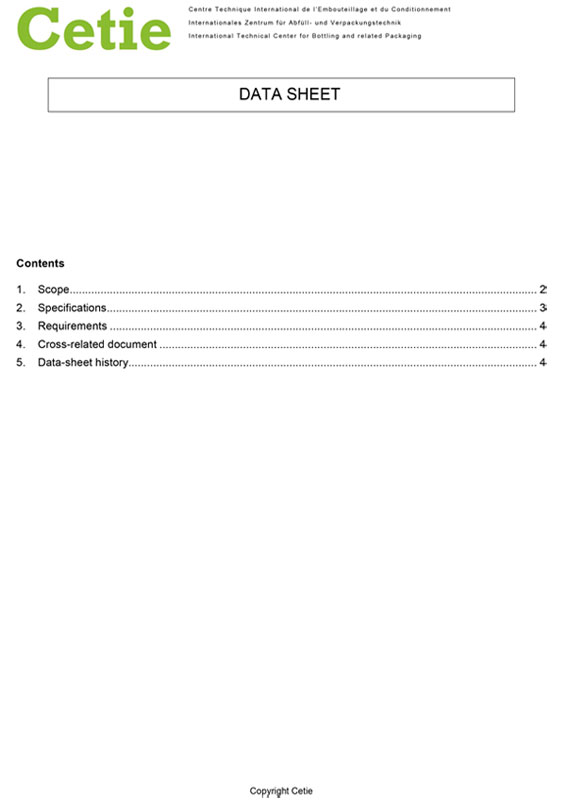 Indicative list of documents
GME30.43 - PET finish 47/41-19,5-3/3,40
GME30.44 - Lightweight PET finish 29/25-12,6-3/2,17
DT02.00 - Standard tolerances for glass containers
DT08.00 - Special strength properties of new glass containers
DT41.21 - Characterisation of cullet treatment plant (CTP) samples
FS22.00 - Measurement of labelling surface flatness of glass containers
GME30.41 - PET finish 26/22-13,4-1/2,3
GME30.70 - PET snap-on neck finish 26/21-8,5 mm
GME30.35 - BVS MCO PET FINISH 21,4/16-29-1/2,5
GME30.36 - PET finish 32/27-14.9-2/2,7

Upcoming meetings
10/06/2026 - B.R.A.V.O.
9H00 - 12H00
Cetie
Meeting Microsoft Teams
Join: https://teams.microsoft.com/meet/347091190779420?p=qwLSisEawTjpnomvf7
12/06/2026 - CAP WG1 & GLASS WG3 (Microplastics) 9H00 - 12H00 TEAMS Dedicated to microplastics
Microsoft Teams Meeting
Join: https://teams.microsoft.com/meet/311722952574120?p=mLeeFpMOqhY4Tl37nr
15/06/2026 - Guide N°17 10H00 - 12H00 TEAMS
17/06/2026 - PET PLENARY 14H00 - 17H00 TEAMS
Join: https://teams.microsoft.com/meet/347091190779420?p=qwLSisEawTjpnomvf7
12/06/2026 - CAP WG1 & GLASS WG3 (Microplastics) 9H00 - 12H00 TEAMS Dedicated to microplastics
Microsoft Teams Meeting
Join: https://teams.microsoft.com/meet/311722952574120?p=mLeeFpMOqhY4Tl37nr
15/06/2026 - Guide N°17 10H00 - 12H00 TEAMS
17/06/2026 - PET PLENARY 14H00 - 17H00 TEAMS

